

Published August 2026
In this article you'll learn:
✅ Why overthinking happens.
✅ The common signs of overthinking.
✅ How it can affect your health and wellbeing.
✅ 8 practical ways to break the cycle.
✅ How Cognitive Behavioural Hypnotherapy can help.
Do you ever replay conversations in your mind long after they've ended?
You’re not alone, I found researching this piece so interesting. Primarily, the inspiration for this blog came through conversations with clients, friends and family. It’s something most of us experience at some point in our lives, if not more often. For example, perhaps you lie awake wondering, "Did I say the wrong thing?" or "What if I've upset someone?"
Maybe your mind jumps to the worst-case scenario before you have any evidence, or you spend hours worrying about things you can't control.
Overthinking is the habit of repeatedly dwelling on thoughts, situations or future possibilities without reaching a helpful conclusion. However, when it becomes a habit, it can affect our sleep, stress levels, confidence, relationships and overall wellbeing.

What Does Overthinking Look Like? (Some may resonate others not so much. See how many resonate with you)
🧠 Replaying conversations over and over.
🧠 Worrying you've offended someone.
🧠 Obsessing over interpreting the meaning ‘in-between the lines’ in conversations, texts or emails. (and assuming the worst!)
🧠 Wondering what other people think of you.
🧠 Struggling to make decisions.
🧠 Imagining negative outcomes without evidence.
🧠 Dwelling on mistakes from the past
🧠 Predicting what might happen in the future without evidence
As a Cognitive Behavioural Hypnotherapist, I see this pattern regularly.
Overthinking isn't a mental health condition in itself, however, if left unmanaged, it can be a contributing factor to many different issues such as anxiety, low mood, stress and even poor sleep.
Why Do We Overthink?
Our brains are a problem-solving machine, and our default setting is designed to keep us safe. And in a world where our minds can be so overstimulated by technology, news and everyday worries, it’s having to work harder than ever.
Sometimes, however, the brain can make mistakes and interpret uncertainty as danger. Instead of finding a solution, it keeps searching for one, and replaying the same thoughts, even when there isn't an answer to be found.
The Impact of Overthinking on Your Health
You can find your thoughts stuck in a negative cycle of overthinking. Whilst not a mental health condition, the tension, worry and anxiety it creates can contribute to things such as:
- Mental health: Persistent overthinking can increase feelings of anxiety and, over time, contribute to low mood or depression.
- Sleep: Overthinking can make it difficult to fall asleep, stay asleep or return to sleep after waking, increasing the risk of insomnia and leaving you feeling tired and less able to cope during the day.
- Digestive health: There is growing evidence that stress and anxiety can affect the gut, contributing to digestive symptoms such as IBS, changes in appetite and a sensitive stomach. For people with inflammatory bowel disease (IBD), stress may also contribute to flare-ups, although it is not the underlying cause.
- Skin health: Your skin is your body's largest organ and can be affected by stress. For some people, stress and anxiety can trigger or worsen skin conditions such as eczema, psoriasis, acne or alopecia.
- Immune system: When you're under prolonged stress, your body releases cortisol, the primary stress hormone. Persistently raised cortisol levels can affect how well your immune system functions, making you more susceptible to infections and potentially slowing recovery.
8 Practical Ways to Break the Cycle of Overthinking
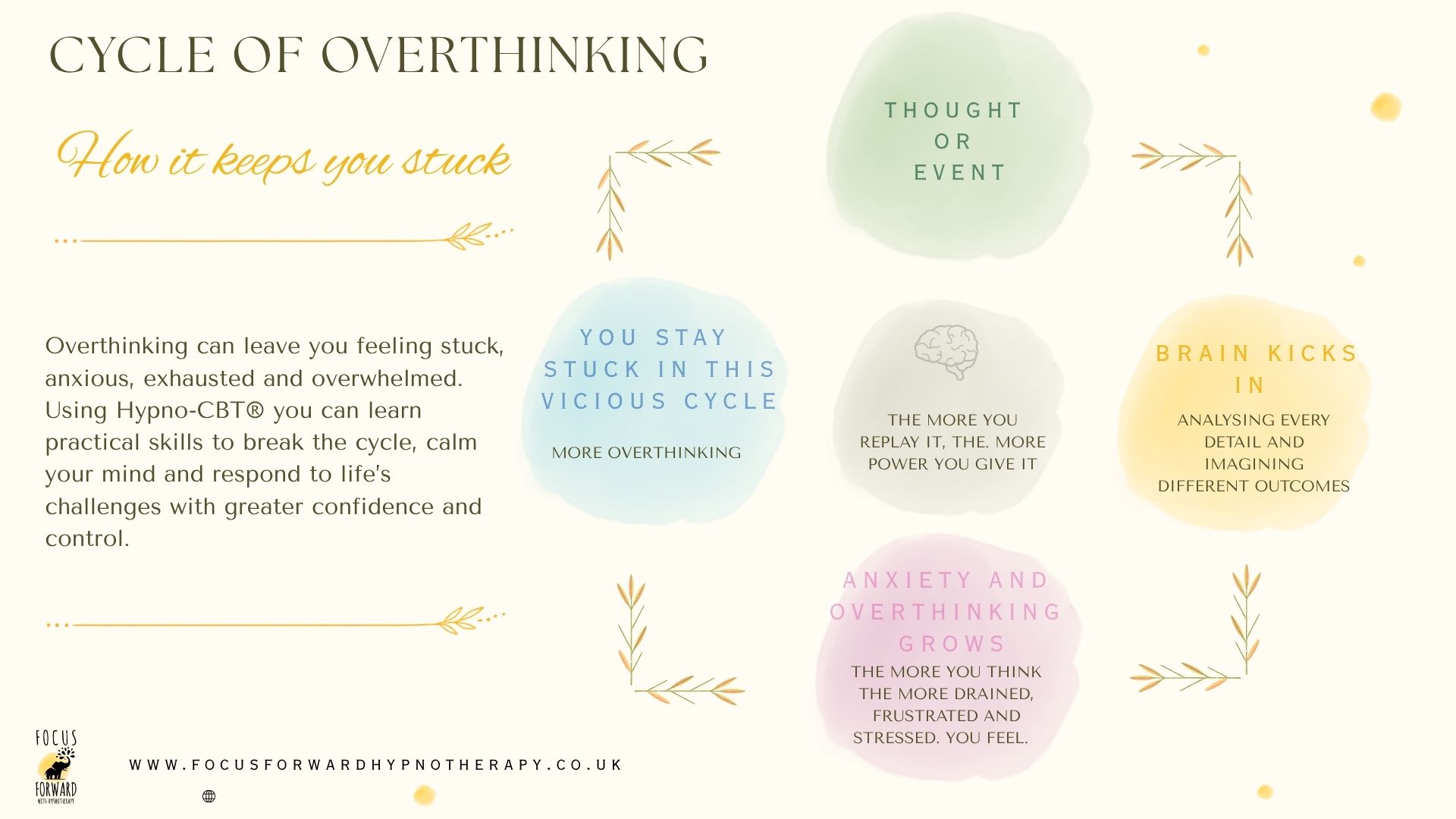
If you’ve recognised yourself whilst reading this, that’s already a step in the right direction. Awareness is the beginning of change and with the right support and a plan of action, it is something you can learn to overcome.
- Notice – start practising awareness, and noticing times when you find yourself overthinking. You may start to notice a pattern developing, times when it's more common.
- STOP – when you notice a pattern and interrupt it.
- Experiment with trying something different. Reframe the scenario, imagine positive outcomes, for instance. Ask yourself: Is this a fact or a fear?
- Ask yourself – ‘What evidence do I have that this is true? Is there another explanation?
- Ground yourself and make positive changes. Go for a walk, have a glass of water, call a friend or do something spontaneous.
- Practice letting thoughts come and go without giving them your attention. There's a very useful free download called "Clouds in the Sky," designed exactly for this purpose.
- Don't run from thoughts that need addressing – if something needs solving, practice problem-solving and work out a solution.
- Accept what you can't change and uncertainty – if it's something you can't change, accept the thought and take tiny steps forward.
Client Experience
(Shared with prior permission from the client, name changed.)
The Challenge
Sunita came to see me as she found herself worrying more and more about her children's future. She had a boy and a girl, her son was 15 years old and about to take his GCSEs, and her daughter was 13. She was overthinking the outcomes of the exams, and the anxiety was waking her up during the night regularly. This had an impact on her sleep and energy levels, and she found herself forgetting things, being more short-tempered with the children as she was tired, and her work was suffering too. It was starting to make her feel depressed and low.
The Work
Working together, we first addressed what was going on, and Sunita recognised that she was caught in a negative cycle of overthinking and worrying. She started to recognise that although her worries were valid, it was something out of her control, and there was nothing she could do to impact the outcome. We worked on ways she could help herself with relaxation, calming her nerves when the thoughts kicked in, and then focused on her health and wellbeing. She started exercising a bit more, going for daily walks in nature and being present, not allowing thoughts to take over. Her walks became precious time for her.
The Outcome
Gradually, her energy began to grow, she spent positive time with her husband and children, supporting them. We used Cognitive Behavioural Hypnotherapy, an evidence-based approach, to help her achieve her goals. The hypnosis helped Sunita embed the positive changes in her life. Sunita began using self-hypnosis regularly to help visualise her future in a positive way. She is now much less anxious and is able to manage her overthinking positively.
Overthinking can make you feel trapped inside your own mind, but it doesn’t have to stay that way. With the right tools, it’s possible to quieten the constant mental chatter, sleep more peacefully and feel calmer and more in control.
If overthinking is affecting your mental health significantly, it's also worth speaking to your GP alongside seeking therapeutic support.
If you’d like support with overthinking, anxiety or racing thoughts, I’d love to help.

Lisa Lewisohn is a Cognitive Behavioural Hypnotherapist and founder of Focus Forward Hypnotherapy. Trained with the UK College of Hypnosis & Hypnotherapy, she uses an evidence-informed approach, Hypno-CBT®, a unique blend of Hypnotherapy, Cognitive Behavioural Therapy (CBT), mindfulness and breathwork, to help clients overcome stress, anxiety, overthinking and unhelpful habits. She regularly helps clients overcome insomnia, racing thoughts and anxiety, supporting them to build healthier sleep habits. Her approach is this: "Small steps make a big difference."
Lisa works with clients in person from her practice in Kingston upon Thames and online, supporting people across Richmond upon Thames, Wimbledon, Teddington, Surbiton, New Malden, Esher, Twickenham, South West London, and throughout the UK.